Icebergs!
Icebergs are pieces of ice that formed on land and float in an ocean or lake. Icebergs come in all shapes and sizes, from ice-cube-sized chunks to ice islands the size of a small country. Icebergs are very dangerous to ships, and many ships have sunk after crashing into icebergs. The most famous one was RMS Titanic in 1912 The North Atlantic and the cold waters su rrounding Antarctica are home to most of the icebergs on Earth.
 rrounding Antarctica are home to most of the icebergs on Earth.
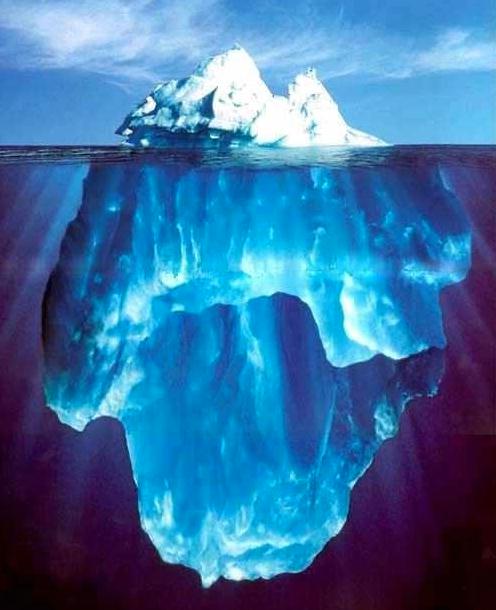
About 90% of an iceberg is below the water line and ten percent above. Just by looking at the part you can see, it is hard to tell how the part underwater looks, and how close you can get before crashing into it. Icebergs are dangerous for ships, especially during the months of April, May, and June.
Icebergs break off from larger structures made of ice, like glaciers or ice shelves. These are formed by snowfall in very cold places where it won't melt in the summer. The snow builds up and compacts into ice. This is gradually pulled downhill by gravity and into the sea. The ice then falls off and makes icebergs. The icebergs can drift in the sea for years before they have melted completely.
The biggest iceberg people know about was called B-15. It broke off from the Antarctic ice shelf in the year 2000, and was as large as the island of Jamaica (over 10,000km2). It soon started to break up into smaller pieces, some of which still remain in 2008.

The weight of an iceberg can be up to several million tons.
When iceberg ice melts quickly, the bubbles released from it make a sound like soda water fizzing.
As icebergs travel southwards they experience significant reductions in size and shape. By the time they reach Newfoundland waters they have lost about 85% of their original mass.
It can take icebergs up to three years to reach the coast of Newfoundland.

The interior temperature of an iceberg is between -15 and -20 degrees Celsius.
Icebergs are really white. This color is created by white light reflecting off tiny air bubbles trapped in the ice. There are also some antiseptic-blue overtones to it and a whole spectrum of green where the iceberg descends into the ocean.
Bibliography:



Huda you have posted a good reflection.About your topic (icebergs) wouldnt' it have been better to include sub headings? Also were you talking about icebergs generally or how they are formed? Your title should reflect this.
ReplyDeleteohh okay miss... yea i think it would have been bettr with sub headings..i was kinda talking on both :p
ReplyDeletehuda u've done a really good job ...keep it up ! i love wat u rote abt the Icebergs... its an amazing topic ^^
ReplyDelete